
After the Women’s Art Movements:
inheritances of care and relationality in contemporary art.
YEAR
2026
PUBLISHED IN
Artlink Issue 46:1, 2026. View Artlink Article
After the Women’s Art Movements
inheritances of care and relationality in contemporary art.
The Women’s Art Movements
emerged in the 1970s across Australia
with organisations incorporated
in Sydney, Melbourne, Adelaide,
Canberra and Perth (1974-1990) and
more informal groups in other cities
and regions. The movement’s core
business was to revise history and
promote women’s art through political
activism, exhibitions, photographic
slide archives and art history. North
American feminist writer, Lucy
Lippard, campaigned for the creation
of archives on women artists and
visited Australia on several occasions
and today the Women’s Art Register in
Melbourne, established in 1975, is the
longest running archive of its kind.1
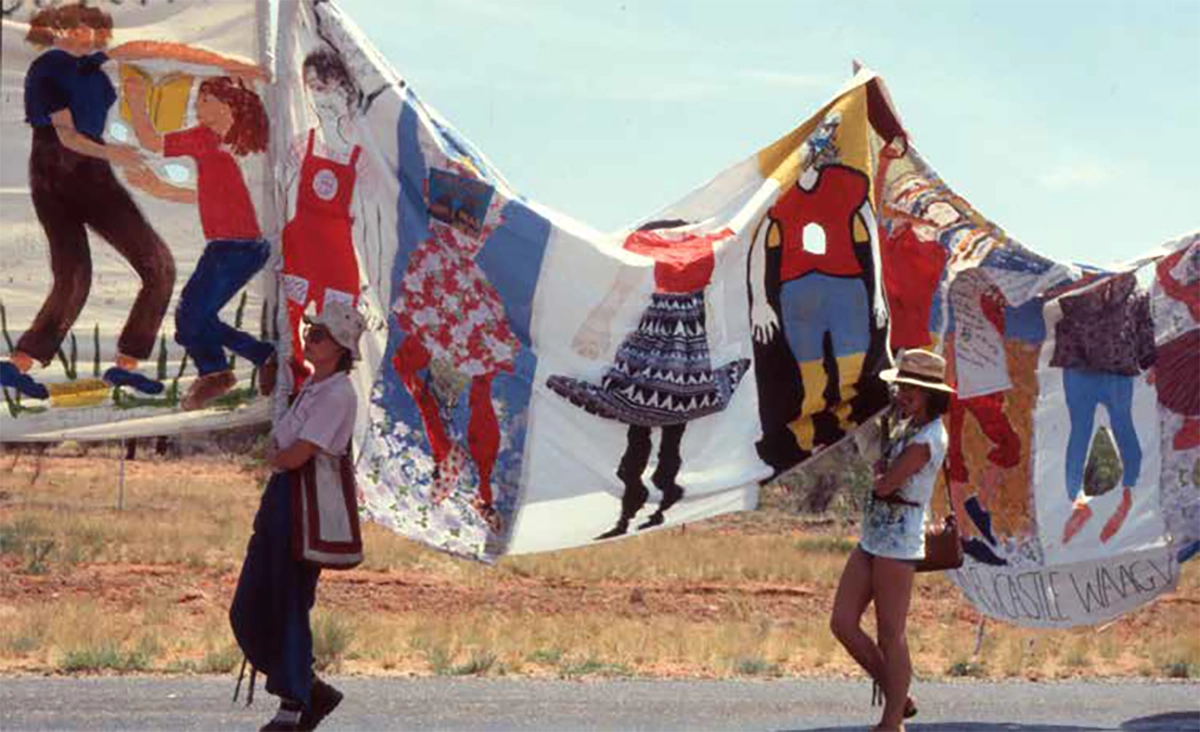
Pine Gap Banners, 1983 Each banner 2m high, width variable; stitched together to make a 1 km long banner Photo: Frances (Budden Phoenix) Jessie Street Women’s Liberation Library Archive, Sydney © Frances (Budden) Phoenix Estate
One of the most lasting and radical inheritances from the early feminist art movements is the practice of sharing personal experience in small groups. The nurturing of art through mentoring is not new; it has its genesis in medieval guilds, but these were strongly fraternal affairs. The Women’s Art and Liberation Movements embraced a small group form of mentoring that aimed to break down hierarchies. The collectives and consciousness raising groups did not support masters or reward authority, everyone was presumed equal, though this utopianism was not without problems as internal conflicts within groups always emerge. However, the idea of equality for all, of intersectional differences and complex histories built across generations, still resonates in contemporary and experimental art today. From these noisy but humble beginnings a huge wave of seemingly unstoppable practice emerged that would sweep through the art schools and every layer of the art world, from political, experimental and contemporary art spaces to mainstream galleries and museums. The practice would inform and rewrite art history through exhibitions, books, magazines, and conferences. Feminism was here to stay, and it certainly has not quietened down.
catastrophes of wars drove the campaign for peace and compassion after the 1970s. The 1983 women’s protest at the US military facility at Pine Gap in Central Australia involved a kilometre-long procession of two-metre-high banners made by women artists and activists from across the country. The works were sent to Alice Springs, stitched together, and then carried by 600 women to create one of the most visible protests against the facility.
Indigenous women activists played an important part in the Pine Gap protest and First Nations artists have permanently inscribed a history of land, culture and Country which emphasises care and compassion and informs much contemporary practice today. SJ Norman presented some of the first intimate one-on-one participatory performance art works in Australia. In Rest Area (2006- 11) members of the audience could lie down in bed with the artist and be cuddled, spoon-like, for fifteen minutes. Imagine how a white person enters this space to be comforted, loved by an Indigenous person: feel the affect and imagine the complexity of the relationship for these fifteen minutes. Julie Gough focuses on Indigenous history in Tasmania and presents powerful installations about the stolen generation and the frontier wars informed by her historical scholarship. eSome Tasmanian Aboriginal children living with non-Aboriginal people before 1840 (2008) is a cluster of burnt tea-tree sticks carved with the children’s names and held together through a seatless found chair with burnt legs, representing the retribution of mothers and families who often set fire to the stockkeeper’s huts to protest the stealing of their children.
From the 1970s onwards, climate and the environment were major themes in performance art, landscape and performative photography, sculpture and site-specific installations. A generation of printmakers working alone and in collectives such as Redback Graphix (Wollongong), Earthworks Poster Collective (Tin Sheds, Sydney), Jillposters and Another Planet (both Melbourne) and Garage Graphix (Western Sydney) to name only a few, consistently made activist posters for political campaigns. The 1984 poster for NAIDOC Week featured a painting by Kaapa Mbitjana Tjampitjinpa, one of the founders of Papunya Tula Artists, and ran with the text Take a Journey of Discovery – To the Land, My Mother. The idea resonated nationally and became embedded in the cultural understanding of a nation. Like the feminist slogan ‘the personal is political’, the idea of ‘the land as mother’ took off as a concept that would inform generations.
been seen in art history. The intimate personalisation of art in daily life through gritty diary entries and photo documentation became living themes that would be taken up generation after generation. The personal is political erupted in the personal as art.
There was a turn to critical theory in feminist scholarship in the 1980s as a result, or perhaps an extension of, issues and critiques arising in and from the 1970s. Some of this was influenced by the pluralisms of the times and by film theory and criticism that started to infiltrate a tired patriarchal art history. The concept of the gaze, that the woman/other is the passive object of the (male) gaze, and the man/master is the active subject—the maker of meaning—subsequently ignited a database of imagery and criticism by artists, activists and academics that contested this position. The gaze became one of the most hotly contested issues in the cultural sphere from the 1980s onwards and its female, feminist, Indigenous and queer interpretations gave rise to another huge wave of contemporary art. The theoretical turn, as it is sometimes called, emboldened artists and scholars who drove ideas and positions visually, politically and philosophically so that voices from dynamic positions of difference could be heard. Internationally influential feminist theorists from Australia, such as Elizabeth Grosz, Meagan Morris, Rosi Braidotti, Sara Ahmed and others were powerful voices who together created a substantial intellectual discourse. Today, Ahmed and Braidotti are leaders in the fields of affect, empathy and relational theory.
The personal and political dynamic that early women’s movements embraced resonated with artists working across various media who embraced the body and psycho-social identities. The role of film and photography cannot be underestimated in the larger view of this history, because these time-based or ephemeral forms often relied on documentation. This was partially archived by alternative art spaces and some of this entered university, community and library archives, now forming key evidence of women’s historic practices. But the living power of these photographs was the influence they had on photography, a medium saturated by the concept of the gaze. The theory that developed around film and photography created a fertile ground for artists exploring gender and power. By the 1990s performative photography was one of the most compelling modes of practice in the arts and it allowed a psycho-social analysis about the self, body, sexuality and identity on print or screen.
Every decade since the 1970s has produced major events and significant scholarship in both art history and curatorial practice. After 2000 the explosion of feminisms and the recognition of intersectionality that enriched relational platforms developed by identity politics and feminist standpoint theory paved the way to rewrite everything. One among many examples is the work of Aileen Moreton-Robinson, whose ground-breaking Talkin’ Up to the White Woman: Indigenous Women and Feminism (2000) was a strong critique of white feminist scholarship, adding a vital and often missing critical perspective to the dialogue.
Sharing economies in art today
Participatory, collaborative and inclusive processes challenge the conventional idea of the individual artist and create possibilities that can destabilise the binary oppositions that have been predominant in Western culture, language and philosophy. These sharing economies offer ways of doing art rather than being an artist.
Participatory and collaborative practices were established in women’s art in the 1970s and created a legacy of networks, events and actions that linked activism and art. The Pine Gap women’s protest, the Knitting Nannas Against Gas and Greed who campaign against coal seam gas (2012- 2026), and a range of performance art actions and artists’ enterprises enable many people to be heard. One of the most successful women’s enterprises in the arts is the Tjanpi Desert Weavers from the NPY Lands, named by anthropologist Jennifer Loureide Biddle as part of a remote avant-garde for their spectacular sculptures and installations.2
There are now a vast number of artists who have embraced participatory and collaborative processes. Below I present recent works that focus on a range of community relations, including participating with AI, that enable difference and new models of cohesion through activism.
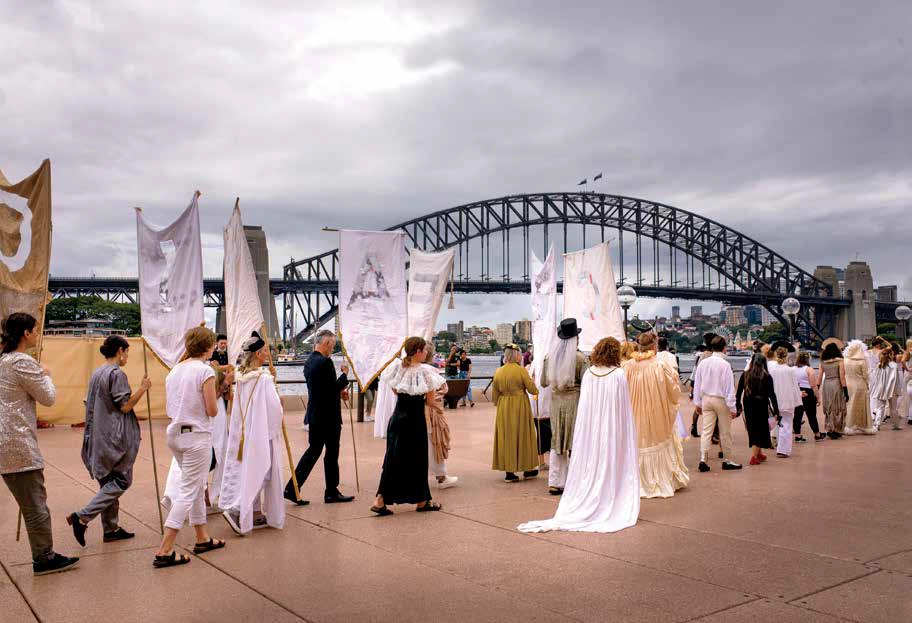
Deborah Kelly CREATION procession, 2021 performance, dimensions variable Sydney Opera House Photo: Meg Hewitt
Deborah Kelly has consistently worked in collaborative modes. Most recently she has been working with a diverse and multifarious choir with art worker collaborators to invent a queer, climate change religion called CREATION. The choir creates performances in public space and galleries. The costuming is queer sci-fi inspired, and the choir often performs with projections of Kelly’s fantastical collages—in collaboration with animator Melody Pei Li—that celebrate a queer world view. The performances are a result of community workshops, networking, and collaborations. Kelly commissioned SJ Norman to write the Liturgy of the Saprophyte which formed the sacred literature for CREATION. The aesthetic tenor of the events emerges from this text, and the approaches of the creative collaborators. Angela Goh and Seet Dance developed the movement and choreography, Alia Ardon’s cinematic overview contributes to the look, Lex Lindsay took on musical direction, the band Stereogamous and a host of poets and singers create the performances in different locations. In every community where the performance occurs, there is a call-out for singers to participate. Kelly plays lots of roles in this big endeavour; asked recently why she wanted to create a new religion she said:
It struck me that part of the tangled crises we’re paralysed by is the splintering of belief systems. We see it manifesting in the reality-breaking phenomena of disinformation wars ... Founding a religion was the only way I could imagine to collectively process these terrifyingly high stakes...3
Creating histories is also at the core of documentary practices, living and historical archives. Alex Martinis Roe’s practice focusses on feminist genealogies and builds relationships across generations as a way of participating in feminist histories. She creates dialogical projects that are built on deep listening and conversation that enables co-writing and co-authoring of video documents. She sees this practice as part of a global network of activism and says that the films/videos are a post-object challenge to the stable archives housed in institutions. Roe is interested in story telling methodologies and what, why and how people remember. Her project documents activism through the stories she gathers with women in different communities who have strong historical engagement in acts of resistance; these acts are thereby accorded a memory through the documentary film process.
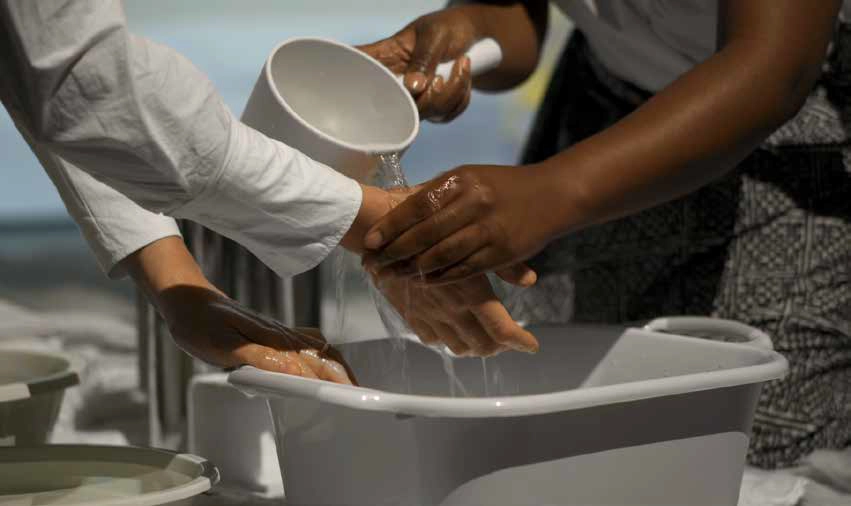
Alex Martinis Roe and Gladys Kalichini, Mnemonic Rituals, 2025 video still from 4K video with sound duration 15:41
In Storytelling Liberation (2025) Martinis Roe collaborated with Katerina Teaiwa (Savusavu, Fiji/Canberra), ASKI Contemporary Greek Social History Archives, Gladys Kalichini (Lusaka, Zambia/Frankfurt, Germany), Alexandra Juhasz (New York City, USA), Andre Ortega (Puebla, Mexico) and Diana Betanzos (Mexico City). Together they created five separate short films about the activist projects they were involved with. The films were exhibited together in an installation which was setup like a series of open classrooms with screens and adjacent shelves. Theoretical and political books were displayed to show the socio-political and historical context relevant to the dialogues on screen. The overall experience for the visitor was immersive and pedagogical and opened dialogues about activism and resistance.
Mira Oosterweghel works across performance, sculpture and video to explore ideas of queer indeterminacy and affect. In Interview with a clown-cowboy (2023) they collaborate with artificial intelligence and present a conversational audio track between a transsexual artist and an AI vampire clown about their experiences of discrimination and the ways in which society constructs them. The voices are generic educated voices that show little emotion, which creates the feeling of a disembodied performance. As the dialogue unfolds in a discussion of cowboys, queerness, settler-colonial mythology and late-stage capitalism, the video shows the artist in the studio making components of the work, performing with costumes and props, and footage of a party game being played in a suburban backyard. Here the participants ride a mechanical bull or bucking horse in a plastic inflatable chorale, presenting a bizarre juxtaposition which is as humorous and disturbing as the background conversation.
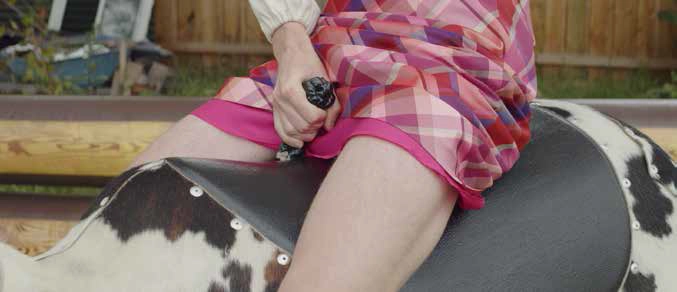
Mira Oosterwegel Interview with a clown cowboy, 2023 still from HD video, duration 17:32. Videography: Ella Sowinska
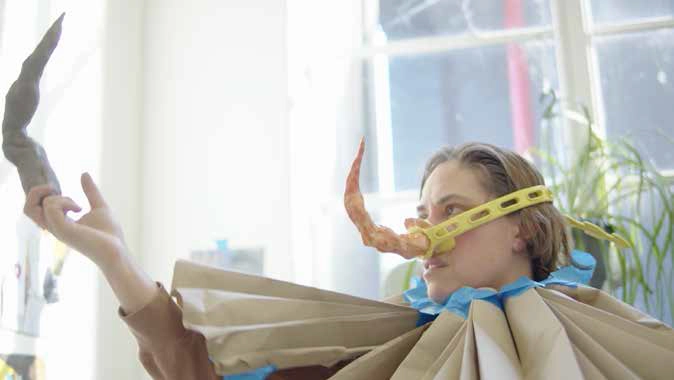
Mira Oosterwegel Interview with a clown cowboy, 2023 still from HD video, duration 17:32. Videography: Ella Sowinska
Oosterweghel is interested in AI malfunctions and sees AI as collective and potentially performative agents with the capacity to generate structural collapse. They see that transness is also a site of transgression that disrupts the continuum of binaries. In Interview with a clown cowboy, the Clown tells the Artist:
I don’t really use the same labels as you but I guess if I was human, I’d be trans. Like I don’t have a gender. Or my gender is Clown, you could say. I’ve often wondered if it’s my physical appearance or my genderlessness that scares people.
Like Oosterweghel, I wonder what happens when enough people introduce non-binary opinions, identities, beliefs, data. Could this kind of human behaviour and interaction with AI change the algorithms to promote ethical thinking, compassion and relationality? It’s a utopian idea but certainly a radical intervention. What is evident in the history of radical, experimental and activist art since the 1970s is that small groups and diverse communities have persistently been at the cutting edge of culture — and electronic communications across the globe means activist-platforms are more in contact, more reachable. AI thickens the mix as it navigates ethical guardrails, learns compassion and has relationships with us. It is an exciting and dynamic time for the arts.
Notes
1 Anne Marsh, Doing Feminism: Women’s Art and Feminist Criticism in Australia, (Melbourne: The Miegunyah Press/ Melbourne University Publishing, 2021), 354-403
2 Jennifer Loureide Biddle, Remote Avant-Garde: Aboriginal Art under Occupation, (Durham and London: Duke University Press, 2016)
3 “Deborah Kelly on creating a queer, science fiction, climate change religion,” (interview with Ineka Dane), Artguide, 28 March 2024.
© 2026 professor ANNE MARSH | SITE BY jamie charles schulz